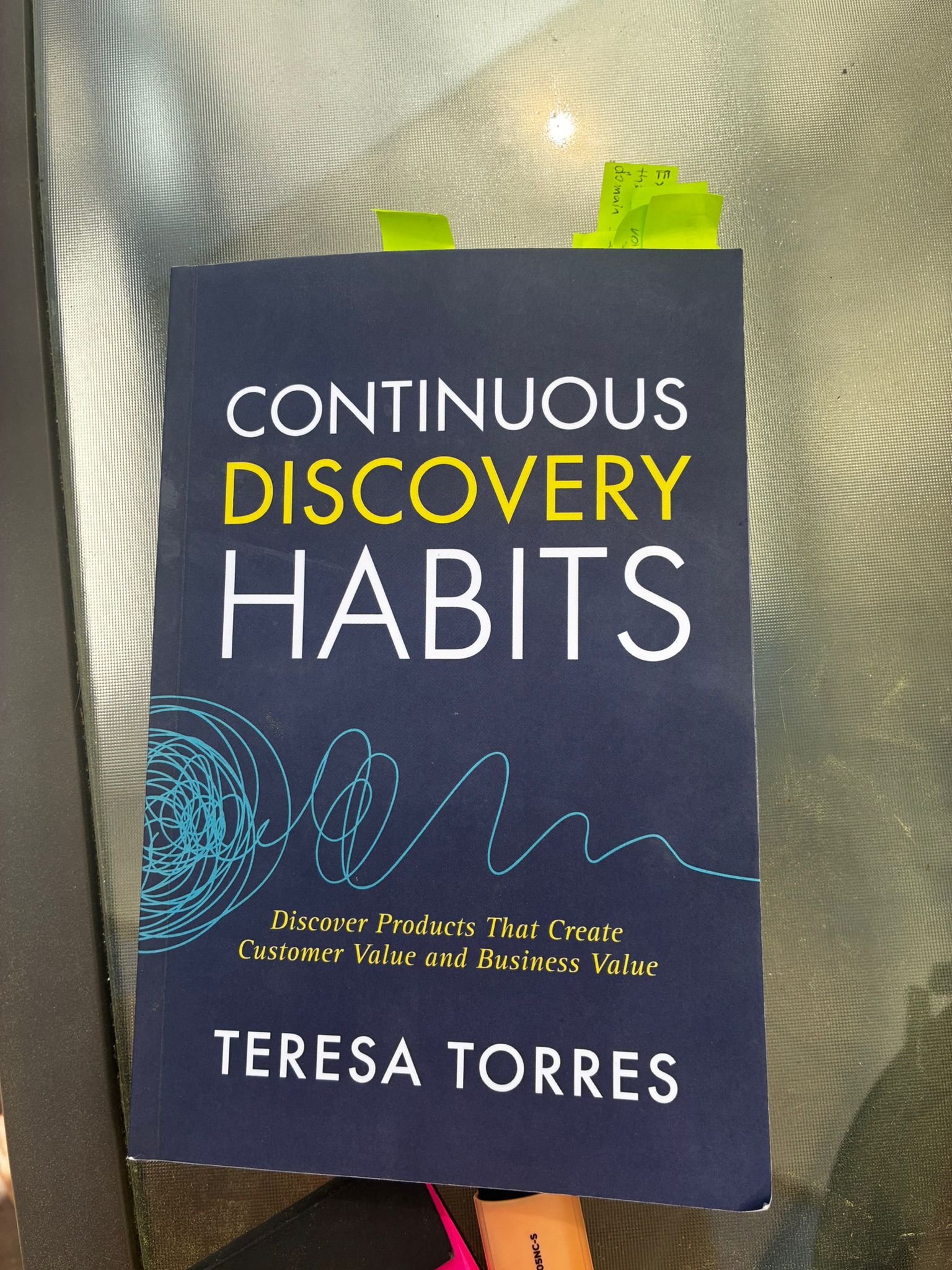
Continuous Discovery Habits
Easy
April 2026
A framework for catching wrong assumptions fast — and building products your customers will actually use, as quickly as possible.
What is this book about?
This book walks you through a set of strategies — and a really practical framework — for creating products your customers will actually use, as fast as possible. Teresa Torres puts a lot of emphasis on catching wrong assumptions fast, so you can iterate quickly during your product discovery journey.
It's not theoretical fluff. It's a concrete playbook for teams that want to stop guessing and start learning.
Who is this book for?
Honestly, I think this book is for anyone looking to build a software product who hasn't been exposed to this kind of thinking before — me, for example. My background is in software engineering, so I've always been working in the solution space, thinking of myself as a delivery mechanism for someone else's ideas.
After reading this, I understand the lifecycle of the products I build so much better. I feel way more capable of:
- Managing teams of developers with a clearer sense of purpose
- Setting priorities for the group based on real signals, not opinions
- Giving overall direction — or better said, helping the team find the right direction
If you're a developer who's ever felt disconnected from why you're building what you're building, this one's for you.
Personal opinion — is it worth it?
Zero doubt: yes.
My only regret is that I didn't come across it a little earlier. It would have saved me and my team a ton of time. This book is one of those rare reads that pulls together pieces of the puzzle that software development actually is — pieces you've been holding in your hand for years without realizing they fit together.
If you're a software developer, product owner, designer, or you just care about building products your customers will love — read it. That's the whole recommendation.
Difficulty
Easy read overall. The prose is clear, the examples ground the concepts, and you never feel like you need to re-read a paragraph three times to get it. You can comfortably get through it in a few sittings.
The score
4.8 / 5
The only reason it's not a full 5 is a personal preference: I would have loved a couple more examples. There are plenty already, to be fair — this is just my nitpicking. It doesn't change the recommendation at all.