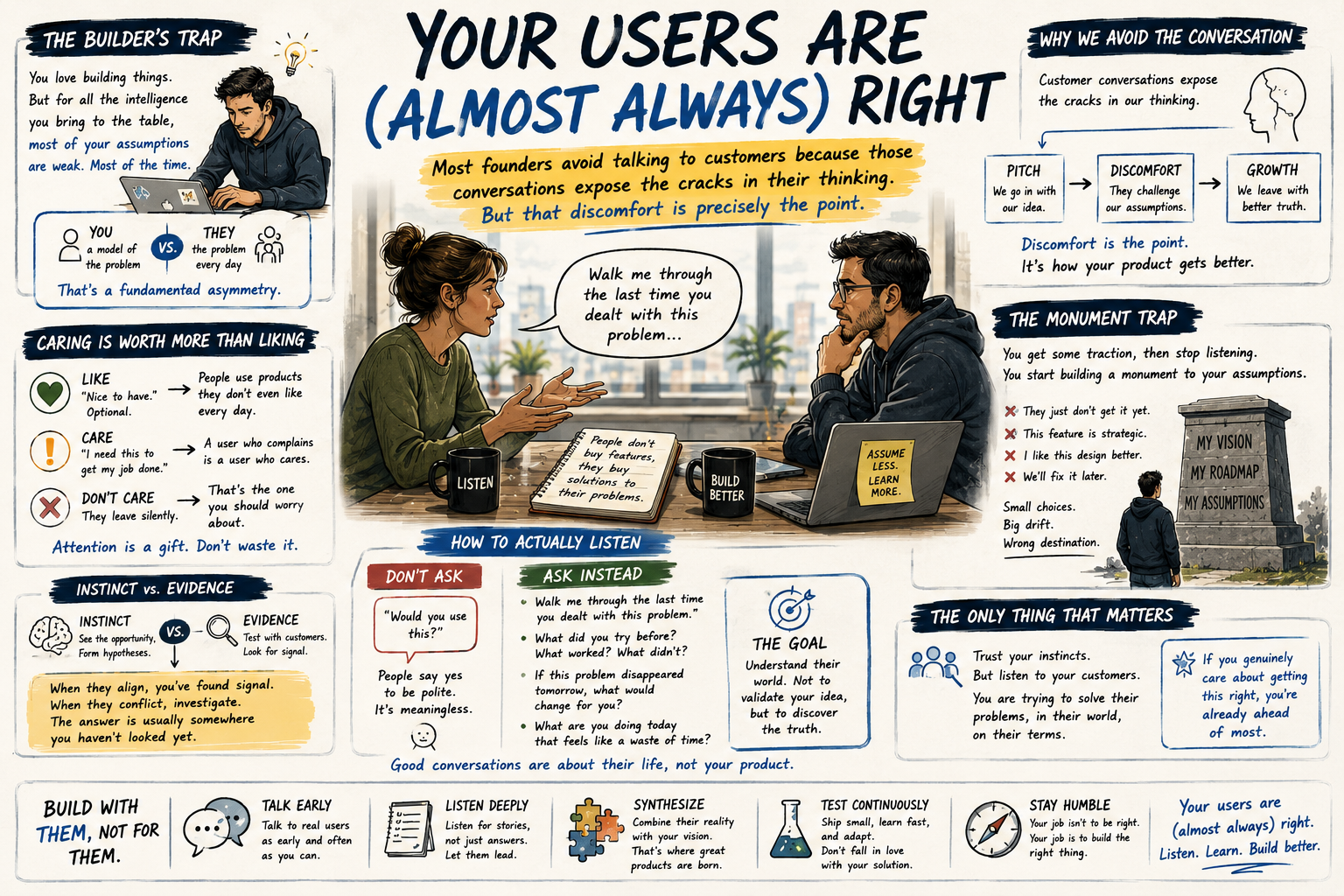
Your Users Are (Almost Always) Right
Most founders avoid talking to customers because those conversations expose the cracks in their thinking. But that discomfort is precisely the point.
After talking to a lot of entrepreneurs, I've noticed a pattern. Most of us think alike, suffer from the same blind spots, and struggle with the same demons. So let me share something I've had to learn the hard way — because if it happened to me, there's a good chance it's happening to you too.
The Builder's Trap
You love building things. You get a rush from solving complex problems and an even bigger rush from the idea of creating something that didn't exist before. That drive is real, and it matters.
But here's the uncomfortable truth: for all the intelligence you bring to the table, most of your assumptions are weak. Not sometimes — most of the time.
That's not an insult. It's a structural problem.
You can't answer a question you've never had to ask yourself. How am I supposed to solve a professional problem I've never lived? You can only know so much about a domain that isn't yours. No amount of research, frameworks, or second-hand knowledge fully closes that gap.
Your customers, on the other hand, live inside that problem every single day. They know more than you. That stings — let it.
Why We Avoid the Conversation
Most founders avoid talking to customers for exactly this reason. Customer conversations have a nasty habit of exposing the cracks in your thinking. You walk in with a pitch and walk out with a list of things you got wrong. That doesn't feel like progress — but it is.
There's a psychological mechanism at play here. Psychologists call it the confirmation bias loop: we naturally seek information that validates our existing beliefs and dismiss signals that challenge them. As a founder, your "existing belief" is your product vision. Every piece of contradictory customer feedback feels like an attack on that vision.
But that discomfort is precisely the point.
Think about the people closest to you — the ones who tell you things you don't want to hear. They do it because they care. Your users are doing the same thing. They're not attacking your product, they're investing their attention in it. And attention is the one thing nobody has to spare.
Caring Is Worth More Than Liking
Here's a distinction most product people miss: caring about a product is worth infinitely more than liking it.
People use products they don't even like every day, simply because they're more convenient than the alternative. Think about that for a second. The bar for "useful" is so much lower than the bar for "delightful" — and yet most founders obsess over the latter.
A user who complains is a user who cares. A user who files a bug report is telling you: "I want this to work because I need it." A user who churns silently? That's the one you should worry about — they've already decided you're not worth the effort.
The users who bother to talk to you are giving you a gift. Most won't. Most will quietly leave. The ones who stay and push back are the ones building your product with you — whether you recognize it or not.
The Knowledge Gap Is Structural
Let me be specific about why your assumptions are usually wrong. It's not a character flaw — it's an information problem.
You operate with a model of the problem. Your users operate with the problem itself.
That's a fundamental asymmetry. You've read about their workflow. Maybe you've observed it a few times. You've mapped it in a Miro board or written user stories. But you've never sat in their chair at 4pm on a Friday, dealing with a broken process while your manager asks why the report isn't done yet.
That lived experience produces knowledge that no interview can fully extract and no persona can fully capture. It's tacit knowledge — the kind that shapes behavior without being consciously articulated.
This is why the best product decisions come from a combination of founder instinct and customer signal. Neither alone is sufficient:
- Founder instinct without customer signal produces elegant solutions to problems nobody has. Beautiful architecture, zero traction.
- Customer signal without founder instinct produces feature factories. You build exactly what users ask for and end up with a Frankenstein product that does everything poorly.
The sweet spot is in the middle: you bring the vision, they bring the reality. You synthesize both.
How to Actually Listen
Knowing you should talk to customers and knowing how to do it well are two different things. Most founder-customer conversations fail because the founder is pitching instead of listening.
Don't ask "Would you use this?" People say yes to be polite. It's a meaningless question.
Ask instead:
- "Walk me through the last time you dealt with this problem."
- "What did you try before? What worked? What didn't?"
- "If this problem disappeared tomorrow, what would change for you?"
- "What are you doing today that feels like a waste of time?"
The goal isn't to validate your idea. The goal is to understand their world well enough that your idea validates itself — or reveals itself as wrong, which is equally valuable.
Rob Fitzpatrick nailed this in The Mom Test: good customer conversations are about their life, not your product. The moment you start describing what you're building, you've lost the signal. Let them talk. The best insights come from the stories they tell when they forget they're being interviewed.
The Monument Trap
Here's where most founders go wrong — not at the start, but after initial traction.
You get your first users. Some things work. You feel validated. And then slowly, almost imperceptibly, you stop listening. You start making decisions based on what you think the product should become rather than what your users need it to be.
This is what I call the monument trap: you stop building a product and start building a monument to your own assumptions.
The signs are subtle:
- You dismiss a repeated piece of feedback as "they just don't get it yet."
- You prioritize a feature nobody asked for because it's "strategic."
- You redesign the UI to match your aesthetic preference, not user behavior.
- You delay a painfully needed fix because it's not "exciting" to work on.
Every one of these choices makes sense in isolation. In aggregate, they compound into a product that slowly drifts away from the people it was built for.
The moment you start looking the other way, you're no longer building a product — you're building a monument to your own assumptions.
Instinct vs. Evidence
I'm not saying ignore your instincts. Your instincts brought you this far. The pattern recognition that made you see an opportunity where others didn't — that's real, and it matters.
But instinct is a starting point, not a destination.
Use instinct to form hypotheses. Use customer feedback to test them. When the two align, you've found signal. When they conflict, don't default to your gut — investigate. The answer is usually somewhere you haven't looked yet.
The best founders I know hold their convictions loosely. They have strong opinions but are genuinely willing to change them when the evidence demands it. That's not weakness — it's the highest form of intellectual honesty.
The Only Thing That Matters
If you're a CTO, a product owner, or an engineer who genuinely cares about getting this right — you're already ahead of most. Most people in your position are building for themselves. The fact that you're thinking about whether you're listening well enough means you probably are. Or at least, you will be.
Trust your instincts. But listen to your customers. You are trying to solve their problems, in their world, on their terms.
If you genuinely care about getting this right, you're already ahead of most. That's the only thing that really matters.