12 months for a result: why neurocognitive assessment needs a process revolution
A patient with Parkinson's waits up to a year to receive the results of their cognitive assessment. The problem isn't medical — it's a process problem. Here's how we're solving it at NeuroSuite.
12 months.
That is how long a patient with Parkinson's waits to receive the results of their cognitive assessment. Not because the doctors are slow. Because the process has too many steps.
The workflow nobody designed
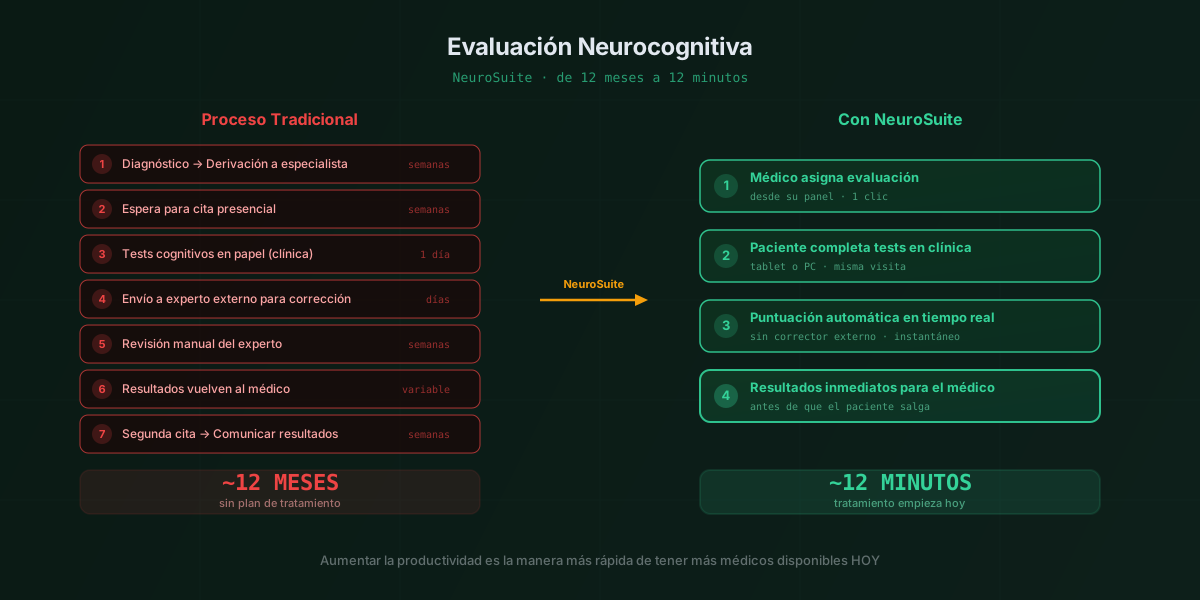
When a patient receives a neurological diagnosis and needs a cognitive assessment, a chain of events is set in motion that seems designed to waste time:
- The patient receives the diagnosis and is referred to a specialist.
- They wait weeks to get an appointment.
- They go to the clinic and complete the battery of cognitive tests on paper.
- Those forms are sent to an external expert for scoring.
- The expert reviews them when they can.
- The results return to the doctor. Eventually.
- Then a second appointment has to be scheduled to communicate them to the patient.
Meanwhile, the disease progresses without a treatment plan.
This is not a medical problem. It is a process problem.
The real cost of waiting
Behind those 12 months lie concrete clinical consequences:
- Delayed treatment initiation — in neurodegenerative diseases, every month counts. An early cognitive intervention plan can slow deterioration, but only if implemented in time.
- Patient and family distress — living for months without knowing the extent of cognitive decline generates uncertainty, anxiety, and a feeling of abandonment by the system.
- Administrative burden on the doctor — every manual step is time the professional is not devoting to the patient. Sending forms, waiting for corrections, scheduling second appointments — it is all friction.
- System overload — every patient who needs two in-person appointments where one would suffice is doubling the demand on an already overwhelmed schedule.
And this is not an isolated case. It is the standard workflow in most neurology departments.
The root of the problem: an analog process in a digital world
The neurocognitive tests used today — MMSE, MoCA, assessments of memory, attention, executive functions — were designed decades ago. Many are still administered on paper. Scoring requires specialized knowledge and is done manually.
The result is a structural bottleneck: the moment of greatest clinical value (interpreting the result) depends on the scarcest resource (the specialist's time).
It is not that technology is lacking. It is that nobody had built the right solution for this specific domain.
How we solve it at NeuroSuite
At NeuroSuite we asked ourselves a simple question: what if the doctor had the results before the patient walked out the door?
The workflow with NeuroSuite:
- The doctor assigns the assessment from their dashboard.
- The patient completes it at the clinic, on a tablet or a computer.
- The system scores in real time.
- The doctor has the results immediately.
No waiting. No referrals to an external scorer. No second appointment to communicate something they should already know.
When someone receives a neurological diagnosis, the last thing they need is months of waiting because of a process that hasn't changed in decades.
From 12 months to 12 minutes
The change is not incremental — it is an order-of-magnitude leap:
| Aspect | Traditional process | With NeuroSuite | |--------|-------------------|-----------------| | Time to results | Weeks to months | Minutes | | Appointments needed | 2-3 in-person | 1 | | Manual scoring | Yes (external expert) | Automatic | | Longitudinal tracking | Difficult (paper records) | Built-in | | Administrative burden | High | Minimal |
But the most important impact is not in the table. It is in what the doctor can do with the time recovered: see more patients, start treatments sooner, and devote the consultation to what truly matters — the patient.
Increasing productivity means increasing capacity
Spain faces a massive wave of specialist retirements over the next decade. We cannot train doctors faster than the rate at which they retire. But we can make every practicing doctor more productive.
Increasing productivity is the fastest way to have more doctors available TODAY.
We do not need to wait for new graduating classes. We do not need to build more hospitals. We need to eliminate the bottlenecks that cause a highly qualified professional to spend their time on administrative management instead of clinical decisions.
At NeuroSuite, that is exactly what we focus on.
What comes next
We are working on expanding the platform to cover more test batteries, integrating longitudinal data that allows tracking the patient's cognitive evolution over time, and connecting with the electronic health record systems already used by hospitals.
The goal is not to replace the doctor. It is to give the doctor back the time that the process steals from them.
If you work in neurology, neuropsychology, or clinical management and are tired of a process that hasn't changed in decades — let's talk.