Spain facing the demographic storm: why optimizing clinical processes is no longer optional — it's urgent
When 69,000 specialists retire over the next decade, technology will be the differentiating factor between a healthcare system that holds and one that collapses.
When 69,000 specialists retire over the next decade, technology will be the differentiating factor between a healthcare system that holds and one that collapses.
Introduction: the problem no one can afford to ignore
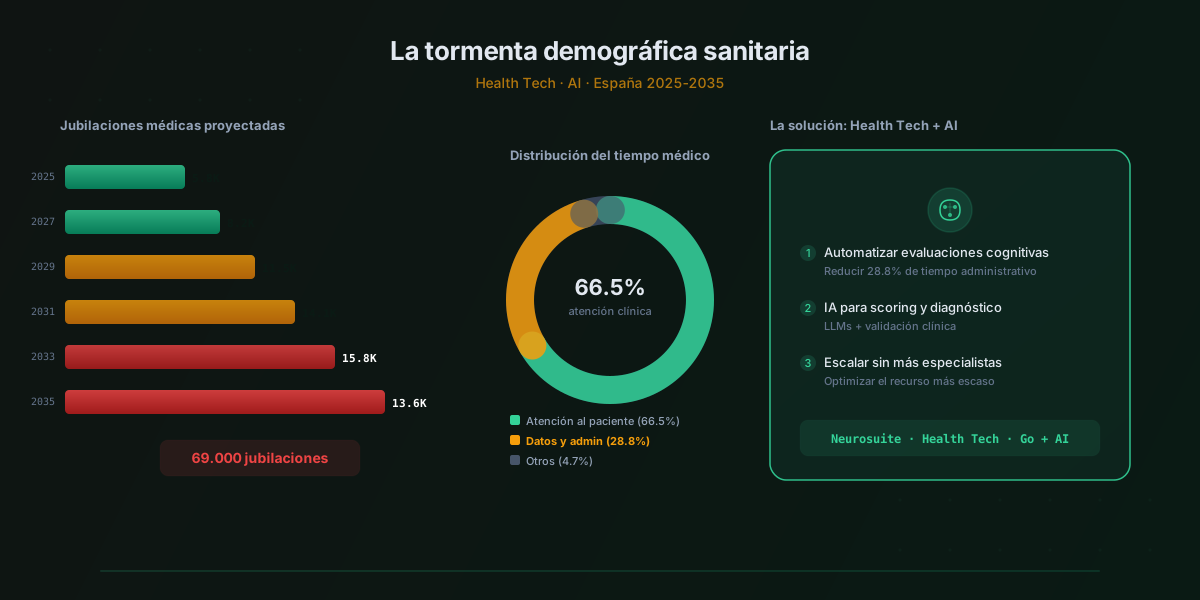
Spain's healthcare system faces unprecedented demographic pressure operating from both ends of the equation. On one side, the accelerating aging of the general population drives up demand for specialized care and the chronicity of diseases. On the other, the medical workforce itself is aging at a pace that compromises replacement capacity. According to the 2025 Medical Demographics Study by the Spanish Medical Association (OMC), Spain currently has 275,963 registered practicing physicians, but 36% of them are over 55. An estimated 69,000 will retire between 2025 and 2035, equivalent to a quarter of the entire current registry.
At a global level, the World Health Organization (WHO) has revised its deficit projection upward, placing it at 11 million healthcare professionals by 2030. In this context, the question is not whether technology should play a role in healthcare, but how much longer we can afford to have medical specialists spend a disproportionate share of their workday on tasks that do not require their clinical competencies.
This article defends a specific thesis: given an increasingly scarce resource — the specialist's time — process optimization through health tech is not a complement, but a condition for the system's sustainability.
1. The demographic snapshot: data that demands action
1.1. The aging of the medical profession in Spain
Spain's medical demographic pyramid presents a clearly inverted structure: a base narrowed by decades of restrictions on training access (numerus clausus) and a top widened by the baby boom generation. The average age of registered practicing physicians is 47.5, but this figure masks alarming disparities. In regions such as Aragon, Asturias, and Castile and Leon, more than 41% of the registry is over 55, meaning that within a decade nearly half of their workforce will have left active service.
The most vulnerable specialties are revealing. Forensic Medicine could lose 57.9% of its practitioners; Occupational Medicine, 57.4%; Clinical Biochemistry, 54.9%; and Clinical Analysis, 51%. But the problem is not confined to minority specialties: Primary Care, the backbone of the system, has been dragging a structural deficit of 4,500 physicians and an especially aged workforce, where one in four professionals is over 60.
1.2. Replacement capacity: necessary but insufficient if the model doesn't change
The OMC projects that, with an average of 4,300 retirements per year and the incorporation of between 8,000 and 8,896 new specialists over the next five years, Spain would go from 168,564 to 180,487 specialists by 2030. The overall balance would be positive. However, this projection rests on conditions that are not currently guaranteed: that new specialists do not emigrate, that MIR residency positions are filled adequately, and that the autonomous communities coordinate replacement. The Federation of Spanish Medical Scientific Associations (FACME) already warns of a deficit exceeding 9,000 physicians across the country.
Moreover, competition for medical talent is now a European phenomenon. Germany projects more than 100,000 medical vacancies by 2035 and offers salaries ranging from 52,000 to 85,000 euros per year for residents, creating a brain drain of young Spanish professionals that is difficult to counter. The Andalusian Medical Union notes that, while shortages are expected in several specialties in the coming years, from 2036 onward the situation could reverse due to declining retirements and increasing graduates, underscoring the critical need for planning that avoids both deficit and surplus.
2. The hidden cost: how we waste the specialist's time
If the healthcare system's scarcest resource is the specialist's time, it is worth examining what they spend it on. And the data is compelling.
2.1. The international evidence
A study published in the Journal of General Internal Medicine found that physicians spend only 66.5% of their time on direct patient care, while 20.7% is devoted exclusively to data entry in the electronic health record (EHR) and an additional 7.7% to purely administrative tasks. In total, nearly 45% of professional time is consumed by interaction with computer systems.
According to American Medical Association (AMA) data, in 2024 physicians reported an average work week of 57.8 hours, of which 27.2 were spent on direct care, 13 on indirect care (data entry, documentation, interpretation of results), and 7.3 on purely administrative tasks such as prior authorizations and insurance forms. The 2023 Medscape report places the average at 15.5 hours per week devoted exclusively to bureaucracy and administration.
A University of Illinois study on primary care concluded that family physicians spend approximately 40% of their time on direct patient interaction and the remaining 60% on non-face-to-face activities. A Harris Poll survey from late 2024 raised the figure further: clinicians spend nearly 28 hours per week on administrative tasks, and 82% reported burnout symptoms.
2.2. The specialist paradox: trained to heal, employed to document
Training a medical specialist in Spain takes between 11 and 12 years (undergraduate degree plus MIR residency). It is, by far, one of the longest and most expensive training pathways in the education system. Yet once incorporated into practice, these professionals devote a significant fraction of their workday to tasks that do not require that training: diagnosis coding, form completion, authorization management, transcription of clinical notes. It is an inefficient allocation of highly qualified human resources.
When 69,000 physicians retire over the next decade and every active specialist continues to spend a third of their day on non-clinical tasks, the cumulative effect is not linear: it is catastrophic. You do not just lose a specialist; you lose the fraction of that specialist who was actually generating clinical value.
3. The health tech response: optimize to sustain
3.1. The productivity argument
The reasoning is straightforward: if we cannot produce specialists faster than they retire, we must multiply the productive capacity of those we have. And that necessarily means freeing their time from tasks that technology can automate, assist, or eliminate.
The evidence already supports this thesis. Researchers at Duke University documented that AI-assisted documentation tools reduce the time spent on clinical note-writing by 20% and after-hours documentation by 30%. At the University of Vermont Health Network, AI ambient scribes reduced after-hours documentation time by 60%. Atrium Health reported that the integration of Nuance DAX Copilot in primary care saves an average of 7 minutes per consultation, enabling up to five additional patient visits per day.
According to a 2025 Canadian report, AI scribes achieved a 69.5% reduction in time spent on administrative tasks in laboratory settings and average savings of 3 hours per week in routine clinical practice in Ontario. When administrative processes are fully optimized with automation, studies point to potential savings of up to 70 minutes per patient visit.
3.2. Beyond documentation: an optimization ecosystem
Clinical documentation is only the tip of the iceberg. The optimization the healthcare system needs spans the entire value chain of medical work: predictive triage that correctly prioritizes patients before they reach the specialist; clinical decision support systems that reduce diagnostic variability; automation of appointment management, referrals, and prior authorizations; remote monitoring tools that enable chronic patient follow-up without in-person consultations; and interoperability platforms that eliminate duplicate testing and information fragmentation.
66% of American physicians were already using AI in their practice in 2024, according to the AMA, up from 38% the year before. And 75% considered that AI could improve their work efficiency. In the words captured in a Google Cloud Healthcare report:
"It's not Gen AI replacing doctors. It's Gen AI letting doctors be doctors."
4. The Spanish case: a window of opportunity that is closing
Spain presents a combination of factors that make this transition especially urgent. It has a universal-coverage national health system with a physician density above the European average (439 physicians per 100,000 inhabitants versus the EU average of 420), but with a profoundly unequal territorial distribution and an incentive structure that pushes talent toward the private sector and toward other countries.
The number of medical schools has grown from 44 to 53, making Spain the country with the most medical schools per capita in the world. MIR residency positions for 2026 total 12,366. But the graduate rate remains below the OECD average (13.6 versus 14.5 per 100,000 inhabitants), and the attractiveness of certain specialties — especially Primary Care — continues to be insufficient.
The demographic window is clear: the decade 2025-2035 will be the one with the greatest pressure. Afterward, retirements will decline and the flow of new specialists could generate a surplus. But it is precisely during this critical decade that technology can make the difference between a system that absorbs the impact and one that deteriorates structurally.
5. My thesis: health tech as a capacity multiplier
My interest in health tech stems from a data-grounded conviction: the greatest return on investment in healthcare over the next decade will not come from training more physicians (which is also necessary), but from maximizing the clinical output of those we already have.
If a specialist spends a third of their workday on automatable tasks and technology can recover between 20% and 40% of that time, the effect is equivalent to adding thousands of virtual specialists to the system without requiring a single additional MIR residency position. It is a pure productivity argument, applicable to both the public and private sectors.
Private healthcare in Spain, with premiums growing at 6.4% per year and already accounting for 28.4% of total health expenditure, has both the economic incentive and the operational agility to lead this transition. But it is the public system that needs it most, because that is where the shortage of specialists has direct consequences on equity and access.
McKinsey reports that 85% of healthcare leaders in the U.S. are already implementing or actively developing generative AI initiatives. Hospitals that adopt these tools report a return of $3.20 for every dollar invested, typically within 14 months. The question is no longer whether health tech will transform healthcare, but who will lead that transformation in the Spanish context.
6. Neurosuite: a concrete example of clinical optimization
Within this analytical framework, it is worth illustrating with a real case how health tech can directly intervene in freeing up specialist time. Neurosuite is a platform designed for healthcare professionals — neurologists, neuropsychologists, psychiatrists, primary care physicians, and private clinic specialists — to administer AI-assisted neurocognitive tests and generate clinical reports instantly.
6.1. The problem it solves
Neurocognitive assessment is an essential process in the diagnosis and follow-up of conditions such as mild cognitive impairment, dementias, ADHD, neurodevelopmental disorders, and the sequelae of acquired brain injury. However, the traditional workflow is extraordinarily intensive in specialist time: manual administration of test batteries, scoring and interpreting results, and preparing detailed reports that can consume between 2 and 4 hours per patient.
In a context where neurologists and neuropsychologists are already saturated, this bottleneck directly limits the number of patients who can be assessed.
6.2. How Neurosuite frees up clinical time
Neurosuite addresses exactly the type of inefficiency that this article identifies as critical. The platform digitizes and standardizes the administration of neurocognitive tests, eliminates manual scoring through AI algorithms, and generates structured clinical reports instantly. The result is that the specialist can focus their time on what truly requires their training: clinical interpretation, integration of the neurocognitive profile with the patient's history, and therapeutic decision-making.
It is, in essence, the same principle that runs through this article's thesis applied to a specific clinical domain: it is not about replacing the specialist, but about eliminating the mechanical tasks that consume their time so they can devote it to the high-value functions where their clinical judgment is irreplaceable.
6.3. Scalability and systemic impact
Neurosuite does not target an isolated niche. Its cross-cutting design enables use in public hospitals, primary care centers, and private clinics, giving it significant systemic impact potential. In a scenario where demand for neurocognitive assessments grows at the pace of population aging — the prevalence of dementia will double in Europe by 2050, according to Alzheimer Europe — having tools that multiply each professional's assessment capacity is not a technological luxury: it is a care necessity.
At Neurosuite, we understand that our contribution fits within a broader transformation. We do not claim to single-handedly solve the healthcare system's demographic crisis, but we do aim to demonstrate that by applying intelligent technology at specific points in the clinical workflow, it is possible to return hours of specialist work to the system. And in the coming decade, every hour will count.
7. The European regulatory paradox: protect without suffocating
Let me be clear from the outset: I am not advocating for deregulation. Regulating artificial intelligence in healthcare is necessary, legitimate, and desirable. Patient safety demands frameworks that guarantee safety, algorithmic transparency, and equity in training data. But there is a difference between regulating intelligently and building a regulatory labyrinth that drives innovation off the continent.
7.1. The dual regulatory layer: MDR + AI Act
In the European Union, a medical device with an artificial intelligence component must simultaneously comply with two top-tier regulatory frameworks: the Medical Device Regulation (MDR 2017/745), in force since May 2021, and the AI Act (Regulation 2024/1689), which entered into force in August 2024 and whose obligations for high-risk systems fully apply in August 2027.
MedTech Europe itself has warned that "the AI Act introduces new obligations for high-risk AI systems that are already regulated under the MDR/IVDR," and that without proper harmonization, these parallel frameworks could slow innovation and complicate compliance. An analysis published in npj Digital Medicine (Cambridge, 2024) details how medical devices with AI are subject to conformity assessments under both regulations — focused on different but partially overlapping aspects — creating what the industry calls a "dual regulatory burden."
Added to this is the GDPR for patient data protection, the NIS2 Directive for cybersecurity, and the new Product Liability Directive. The result is a regulatory triangle — AI Act, MDR, and Product Liability Directive — which, according to White & Case, "tightens the liability of manufacturers of smart medical devices" and may discourage smaller players in the short term.
7.2. The transatlantic gap: 1,016 devices versus paralysis
While Europe debates regulatory frameworks, the United States acts. The FDA had authorized 1,016 medical devices with AI by October 2024, with exponential growth: from 6 in 2015 to 223 in 2023 and 221 in 2024. Its Predetermined Change Control Plans (PCCP) mechanism, finalized in December 2024, allows manufacturers to pre-approve algorithmic update parameters, avoiding complete device recertification with every modification. It is adaptive regulation, designed for the iterative nature of AI models.
In Europe, by contrast, the MDR requires recertification for significant software modifications, while the AI Act contemplates continuous-learning systems but without a mechanism equivalent to the PCCP. A European health tech startup developing a diagnostic-aid algorithm must navigate a process involving notified bodies (whose number has only grown from 20 in 2021 to 50 in 2024, insufficient for demand), dual conformity assessments, and timelines that can exceed two years to market.
7.3. What Draghi says: "Europe innovates, but doesn't commercialize"
It is not just my opinion. The Draghi Report on European Competitiveness (September 2024), commissioned by the European Commission itself, articulates it with devastating clarity: Europe does not lack ideas or ambition, but "innovation is blocked at the commercialization stage, because innovative companies that want to scale in Europe are hampered at every stage by inconsistent and restrictive regulations." Between 2008 and 2021, around 30% of unicorns founded in Europe relocated their headquarters abroad, predominantly to the United States.
The report, spanning 383 pages and more than 170 recommendations, identifies overregulation as one of the key factors in Europe's competitive decline. A year later, the European Policy Innovation Council found that only 11.2% of the recommendations had been fully implemented. In September 2025, Draghi himself stated that every challenge identified in his report had worsened, and called for a pause in European AI regulations to assess their potential negative effects.
In November 2025, the European Commission responded partially with the Digital Omnibus — a package of specific amendments to the AI Act, GDPR, Data Act, and NIS2 — designed to reduce overlaps and increase legal certainty. It is a first step, but it arrives late and does not resolve the fundamental issue: Europe still lacks an equivalent to the PCCP for AI-enabled medical devices, or a proportionate approval mechanism that allows a health tech startup to bring a low-risk product to market within a reasonable timeframe.
7.4. Concrete proposals: regulate better, not less
My criticism is not ideological; it is functional. If we want technology to help solve the healthcare demographic crisis, we need a regulatory framework that enables three things:
- Genuine risk proportionality, so that a clinical documentation aid system does not receive the same treatment as an autonomous diagnostic algorithm.
- Continuous update mechanisms equivalent to the U.S. PCCP, so that models can improve without full recertification.
- Effective and funded regulatory sandboxes, not merely provided for in law but operational, where startups can validate their solutions in real clinical environments under supervision, as the AI Act already proposed but whose implementation by Member States was due by August 2026.
8. Building a health tech startup in Spain: real progress, persistent barriers
Layered on top of the European regulatory framework is an additional set of difficulties when the venture is based in Spain. It is fair to acknowledge that the Startup Law (Ley 28/2022) represented a significant step forward: a reduced tax rate of 15% for four years, stock option exemption up to 50,000 euros, simplified company formation, a digital nomad visa, and the creation of the National Entrepreneurship Office (ONE). But it is also fair to point out that the ecosystem continues to carry structural deficits that particularly penalize health tech projects.
8.1. The gap with benchmark ecosystems
According to the OECD, Spain occupies an unfavorable position in ease of entrepreneurship. The ecosystem's own assessment, according to specialized legal analysts like Metricson, is that the Startup Law "brings us closer to international standards of incentives and agility, but does not place us at the forefront." Countries like the United Kingdom offer more generous capital gains exemptions for investors; France has maintained specific tax and social contribution regimes for young innovative companies (JEI) for years; and the U.S. ecosystem operates with an incomparably deeper venture capital market.
For a health tech startup, where development cycles are long (clinical validation, regulatory certification, hospital integration) and the return on investment is deferred, this competitive gap is especially punishing. A Spanish health tech entrepreneur competes with the same regulatory timelines as a German or French one, but with less access to capital, fewer sustained tax incentives, and a public hospital ecosystem whose capacity for innovation adoption is constrained by the rigidity of public procurement processes.
8.2. The specific bottlenecks of Spanish health tech
Beyond the tax framework, health tech entrepreneurs in Spain face concrete obstacles that deserve to be named. The self-employment contribution (cuota de autonomos), although the Startup Law exempts it for three years for those who combine employment and entrepreneurship, remains a psychological and economic barrier for clinical professionals who want to innovate without leaving their hospital position. ENISA's startup accreditation, with a processing time of up to three months, introduces a latency that other jurisdictions do not require. And the five-year time limit (seven for biotechnology) to maintain startup status is too narrow for health tech projects that need longer validation cycles.
But perhaps the deepest problem is cultural and institutional: Spain's public healthcare system, decentralized across seventeen autonomous regional systems, lacks an agile and unified mechanism for piloting and scaling technology solutions. The regulatory sandboxes that the Startup Law envisioned for regulated sectors are a promising instrument, but their effective deployment in the healthcare domain has been slow. There is no Spanish equivalent to the UK's NHS Innovation Accelerator or the FDA's Digital Health Center of Excellence that acts as a gateway for digital innovation in the health system.
8.3. What is needed: proposals to unlock Spanish health tech
The necessary measures are not revolutionary; they are logical:
- Extend the startup period to ten years for health tech projects with a demonstrable regulatory cycle, aligning it with the reality of a sector where MDR certification alone can consume more than half of the currently permitted period.
- Create a single healthcare entry point, an agency — or at least a coordinated function — within the Ministry of Health that facilitates the entry of digital innovation into the NHS, with standardized pilot protocols that the autonomous communities can adopt without each replicating its own procedure.
- Activate healthcare sandboxes effectively, with dedicated funding and mandatory hospital participation, not as a theoretical possibility but as a permanent infrastructure within the innovation system.
- Provide tax incentives for public procurement of digital health innovation, so that public hospitals not only can but have economic reasons to adopt solutions that improve their specialists' productivity.
- Strengthen investment incentives for health tech, with specific deductions that recognize the higher risk and longer maturation timeline of these projects compared to other technology sectors.
The Draghi Report notes that internal barriers within the European single market amount to a tariff equivalent of 45% on goods and 110% on services. Spain, with its regional fragmentation, replicates that dynamic on a domestic scale. If we want Spanish health tech to help solve the healthcare demographic crisis, we need the State itself to stop being the biggest obstacle to the solutions the system needs.
Conclusion
Spain faces a healthcare demographic challenge that is simultaneously urgent and foreseeable. Data from the OMC, the Ministry of Health, the WHO, and FACME paint a scenario in which generational replacement of specialists will be insufficient if not accompanied by a profound transformation of clinical work processes.
Health tech is not the complete solution. Human resource planning, improving working conditions, territorial coordination, and Primary Care model reform are essential. But none of these measures has the capacity to multiply the individual productivity of each specialist the way technology applied to the elimination of low-value tasks does.
However, that technology will not emerge spontaneously. It needs a European regulatory framework that protects the patient without suffocating the innovator; it needs a Spanish entrepreneurial ecosystem that stops treating health tech as just another sector and recognizes its specific cycles and demands; and it needs the public healthcare system to abandon institutional inertia and open itself to collaboration with the companies developing the tools that its own professionals are calling for.
Every hour a specialist spends documenting instead of diagnosing, coding instead of treating, waiting for authorizations instead of intervening, is an hour the healthcare system cannot afford to waste. And as the workforce shrinks, every hour will weigh more.
That is the space where health tech can — and must — generate the greatest impact. Not by replacing the doctor, but by giving them back the time to be a doctor. At Neurosuite, we work every day to make that promise a tangible reality in the field of neurocognitive assessment. And we hope many others will join this effort.
Sources and references
- Spanish Medical Association (OMC). 2025 Medical Demographics Study. General Council of Official Medical Colleges, October 2025.
- Ministry of Health. Report on Human Resources, Professional Regulation, and Continuing Education of the NHS 2024. Madrid, 2024.
- Ministry of Health. Supply and Demand for Medical Specialists in Spain (2023-2035). Madrid.
- Federation of Spanish Medical Scientific Associations (FACME). Report on physician shortages in Spain, 2024.
- Andalusian Medical Union / SIMEG. Shortage of medical specialists in Spain: an urgent problem that needs long-term solutions, October 2024.
- WHO. Global Strategy on Human Resources for Health: Workforce 2030. Updated report 2025.
- Boniol, M. et al. "The global health workforce stock and distribution in 2020 and 2030." BMJ Global Health, 2022, Vol. 7(6).
- McKinsey Health Institute. "Heartbeat of Health: Reimagining the Healthcare Workforce of the Future." May 2025.
- World Economic Forum. "Why is the world now facing a medical recruitment crisis?" January 2023.
- Sinsky, C. et al. "How Physicians Spend Their Work Time: an Ecological Momentary Assessment." J Gen Intern Med, 2020. PMC7661623.
- American Medical Association (AMA). National Physician Comparison Report 2024: Work Hours and Burnout Data. August 2025.
- Medscape Physician Compensation Report 2023: Administrative Burden by Specialty.
- Harris Poll / Google Cloud. Survey on administrative burden and clinical burnout, December 2024.
- Tai-Seale, M. et al. "Electronic Health Record Logs Indicate That Physicians Split Time Evenly Between Seeing Patients And Desktop Medicine." Health Affairs, 2017, 36(4):655-662.
- AMA. "Physicians' Greatest Use for AI? Cutting Administrative Burdens." Survey 2023-2024, published March 2025.
- AMA. "2 in 3 Physicians Are Using Health AI — Up 78% from 2023." February 2025.
- CADTH / 2025 Watch List: Artificial Intelligence in Health Care (NCBI Bookshelf, NBK613808).
- Duke University. Audit of AI-assisted documentation tools.
- Atrium Health / Nuance DAX Copilot. Savings of 7 minutes per consultation in primary care.
- Greenway Health / MedCity News. "Easing Frontline Pressure: How AI Can Lift the Administrative Burden Off Care Teams." September 2025.
- Neurosuite (neurosuite.net). AI-assisted neurocognitive assessment platform.
- Alzheimer Europe. Dementia in Europe Yearbook: dementia prevalence projections in Europe through 2050.
- Regulation (EU) 2024/1689 of the European Parliament and of the Council (AI Act).
- Regulation (EU) 2017/745 of the European Parliament and of the Council on medical devices (MDR).
- MedTech Europe. Position on the interaction between the AI Act and the MDR/IVDR.
- Aboy, M. et al. "Navigating the EU AI Act: implications for regulated digital medical products." NPJ Digital Medicine, 2024, 7:237.
- Solomonides, A. et al. "Medicine, healthcare and the AI act: gaps, challenges and future implications." European Heart Journal – Digital Health, 2025.
- White & Case LLP. "New EU Responsibility and Liability Landscape for Smart Medical Devices in a Global Context." 2025.
- FDA. Artificial Intelligence and Machine Learning (AI/ML) Enabled Medical Devices. October 2024.
- FDA. Predetermined Change Control Plans for AI-Enabled Medical Device Software. December 2024.
- European Commission. Digital Omnibus Package, November 2025.
- Draghi, M. "The Future of European Competitiveness." European Commission, September 2024.
- European Policy Innovation Council (EPIC). Draghi Observatory & Implementation Index, September 2025.
- EU–INC. Proposal for a "28th Regime" to harmonize the European business legal framework. September 2025.
- Ley 28/2022 on the Promotion of the Emerging Companies Ecosystem (Spain's Startup Law).
- Metricson. "Tax and Legal Benefits for Startups in Spain (Startup Law)." July 2025.
- OECD. Ease of entrepreneurship indicators by country.