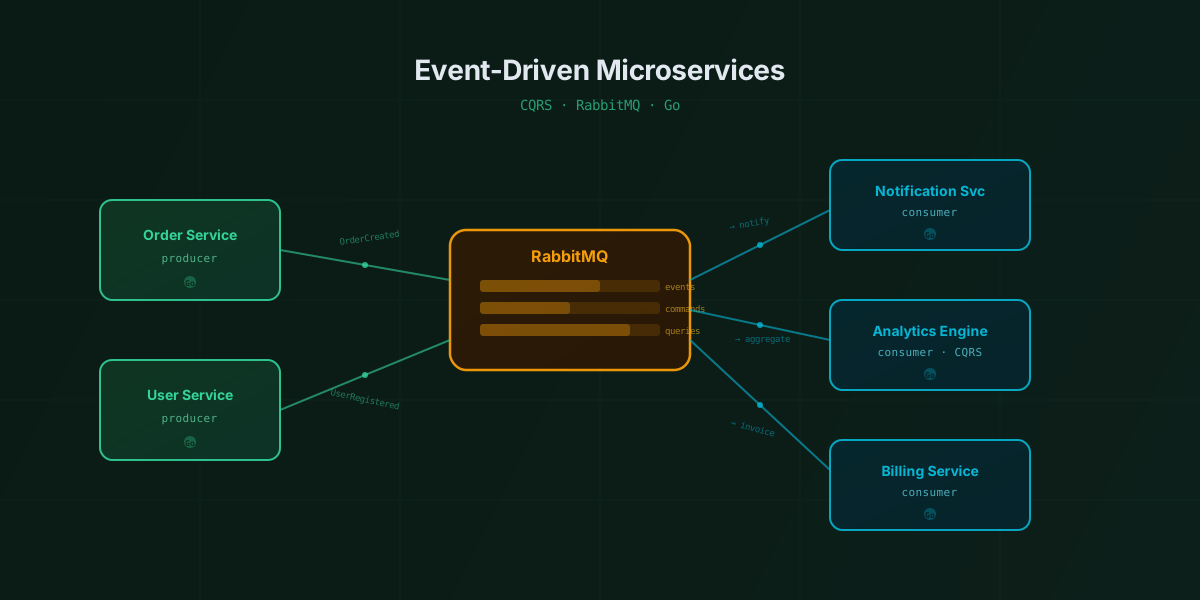
Building Event-Driven Microservices in Go
A deep dive into designing event-driven architectures with Go, covering CQRS, event sourcing, and message brokers like RabbitMQ.
Event-driven architecture is one of the most powerful patterns for building scalable, decoupled backend systems. In this article, I'll walk through how I design and implement event-driven microservices in Go, drawing from production experience.
Why Event-Driven?
Traditional request-response architectures create tight coupling between services. When Service A needs to notify Service B, C, and D about a state change, you end up with a web of synchronous calls that are fragile and hard to scale.
Event-driven architecture flips this: services emit events about what happened, and other services react to those events independently.
Benefits:
- Loose coupling — producers don't know about consumers
- Scalability — consumers process events at their own pace
- Resilience — if a consumer is down, events queue up and get processed later
- Auditability — events create a natural audit log
The Core Pattern
Here's a simplified event structure I use in Go:
type Event struct {
    ID        string    `json:"id"`
    Type      string    `json:"type"`
    Payload   []byte    `json:"payload"`
    Timestamp time.Time `json:"timestamp"`
    Source    string    `json:"source"`
}
Each microservice publishes domain events to a message broker (RabbitMQ in our case) and subscribes to events it cares about.
CQRS: Separating Reads from Writes
Command Query Responsibility Segregation (CQRS) pairs naturally with event-driven systems. The write side processes commands and emits events, while the read side builds optimized projections from those events.
// Command side - handles writes
type OrderService struct {
    repo      OrderRepository
    publisher EventPublisher
}

func (s *OrderService) PlaceOrder(cmd PlaceOrderCommand) error {
    order, err := NewOrder(cmd)
    if err != nil {
        return err
    }
    if err := s.repo.Save(order); err != nil {
        return err
    }
    return s.publisher.Publish(OrderPlacedEvent{
        OrderID: order.ID,
        UserID:  cmd.UserID,
        Total:   order.Total,
    })
}
The read side listens for OrderPlaced events and updates a denormalized view optimized for queries.
Lessons from Production
After running event-driven systems in production, here are the key takeaways:
- Idempotency is non-negotiable — messages can be delivered more than once. Design handlers to be safely re-executable.
- Schema evolution matters — use versioned event schemas so you can evolve without breaking consumers.
- Dead letter queues save you — always configure DLQs for messages that fail processing.
- Correlation IDs are essential — trace a single user action across multiple services.
Event-driven architecture isn't about technology — it's about modeling your domain as a series of facts that happened.
What's Next
In the next article, I'll cover event sourcing — storing the full history of events as your source of truth, and how to implement it efficiently in Go with PostgreSQL.